


Speech of the Month, April 2026 - King Charles III
Sharp jokes, a surprise gift, and an air of genuine delight — Charles III owned the White House State Banquet.
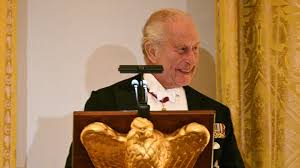
Last month I struggled to find a subject for 'Speech of the Month', but this month there was only one contender: King Charles III. With his barnstorming speeches in the House of Congress and at the White House, he not only did himself and the UK proud, but surprised us all with just how top-drawer he was.
Rather than analysing the speeches — you'll find plenty of that in the broadsheets — the point of 'Speech of the Month' is to consider what we can take from a person's performance, and that's what I'll continue to do. Now, I wouldn't blame you if you're thinking, Yeah, but what is there for me to learn from a speech honed by a speechwriter and delivered to a fawning audience? I understand that. By the end of Charles's speech to Congress, you sensed he could have delivered a filthy limerick and still received a standing ovation. But if we can put the privileges of royalty to one side, there are takeaways.
I'm going to focus on just one of the speeches — the state dinner. If you've yet to see it, do take a look.
He looks like he's enjoying himself
Yet he couldn't have been. Word is, he thinks Trump is an ignorant, odious arse — and yet he had to be pinned to his side for 48 hours, absorbing the president's bragging and bluster. But work isn't always pleasant, and sometimes we just have to suck it up. That's exactly what Charles did. At no point did he betray the fact that he'd undoubtedly have preferred to be somewhere else. Instead, when he rose to speak, he looked like there was nowhere he'd rather be — and more than that, he looked like he was genuinely enjoying himself. A distinct contrast to his late mother who, when speaking at state events, looked like she was dealing with a necessary evil.
Remember to do the same, especially when you're speaking somewhere you'd rather not be. Don't leak those feelings. Work on your material so you like what you're saying, and as you say it, look pleased to be there.
He had great warm-up jokes
Before getting to the serious heart of his speech — the UK's and US's shared love of and fight for democracy — Charles warmed up the crowd brilliantly with a couple of strong jokes. The first was relatively safe: "I can't help noticing the readjustments to the East Wing. And I'm sorry to say that we British made our own small attempt at real estate redevelopment of the White House — in 1814." It received huge guffaws (though not from Melania, who needed it explaining to her). The second was riskier: "You recently commented, Mr President, that if it were not for the US, European countries would be speaking German. Dare I say that if it wasn't for us, you'd be speaking French." Equal guffaws — though you do wonder if Trump got it.
The point is, an icebreaker matters. It's always worth thinking about how you can warm up an audience before getting into your key messages. As Charles demonstrated, a teasing rebuke can work very well — particularly when the vast majority of the room aren't ignorant, odious arses. Know your audience.
He referred to someone close to him that the audience admired
That person was Winston Churchill. Admittedly, Charles can't have known Churchill especially well, but as he was his mother's first Prime Minister and Charles attended his funeral, it's safe to assume some first-hand dealings. We know Trump admires Churchill (or at least prefers him to Keir Starmer) so the story about FDR happening upon a naked Churchill in the White House and saying, "Well, Prime Minister, it's clear to see you've nothing to conceal from me," was a shrewd inclusion. It paid tribute to the wit and warmth of a US president and, in doing so, gave the flattering impression that they're all cut from the same cloth. Ahem.
It's always worth considering whether you've worked with or are close to someone your audience holds in high regard. I'm currently working with a football coach who was trained by Alex Ferguson. I encourage him, where appropriate, to reference the legendary manager and share insider stories. Everyone — regardless of age or gender — loves hearing that kind of thing.
The element of surprise
The obligatory state banquet gift. How many vases and decorative bowls must presidents and monarchs receive? Where do they put them all — and once they have, do they ever recall who gave them? That's not a risk with the King's gift: the Trump Bell. Brilliant. Trump's such an egomaniac he'll probably have it on his bedside table, ringing it in the night when he fancies a Big Mac and waking all the staff.
The point is, it was a genuine surprise. You're unlikely to be unveiling dramatic gifts during your presentations, but you can still deliver a surprise or two. Think about what you can tell your audience that it didn't know — an unexpected fact, a personal disclosure, or something promising on the horizon.


“I highly recommend Emma for voice coaching. She is approachable, engaging and entertaining, and I feel like I have learned a lot. Her celebrity impressions are top notch too!”